Showing posts with label Dahua. Show all posts

Thursday, January 26, 2017

Top 10 video surveillance cameras & NVR of 2016

Top 10 video surveillance cameras & NVR of 2016

In order to come up with a comprehensive assessment, the products on this list all adhere to the following guidelines:
·        The product must have been uploaded to the asmag dot com database between Jan. 2016 and Dec. 2016.
·        The main purpose of the camera must be for professional security; no Wi-Fi cameras, cube cameras, DIY, or cameras targeted at the smart home sector were included.
·        Only one camera per company was chosen.


Top 10 video surveillance cameras of 2016:

1. Hikvision DS-2CD6626DS-IZ(H)S Dark Fighter 2 MP anti-corrosion dome

2. Dahua HD-TPC-PT8320-T hybrid network PTZ camera


3. Axis XF40-Q1765 explosion protected fixed network camera


4. Sony SNC-VB770 ultra high sensitivity 4K network camera
5. Surveon CAM2441HI box network camera
6. LILIN ZR8022 1808p HD Day & Night autofocus IR IP camera
7. EverFocus EZN7221 2 MP Full HD ultra-low light camera

8. Pelco by Schneider Electric Optera 12 MP panoramic IP camera

9. DynaColor DynaHawk ZD series hyper mini fisheye IP camera


10. ITX NCB-2003PR/NCB-1303PR IP camera

Top 10 video surveillance NVR of 2016:

1. Wavestore A-Series NVR


2. QNAP VS-2204 Pro+ VioStor NVR

3. Merit LILIN NVR408M H.264 1080p real-time multi-touch vehicle standalone NVR

4. Milestone Husky M50A NVR
5. Hikvision DS-96128/2561NI-E16(-E24) Embedded Super NVR

6. Hunt HNR-16GSQ NVR

7. Dahua DH-NVR5216/5232-16P-4KS2 NVR
8. Verint Nextiva EdgeVR 100/200 Series NVR
9. EverFocus Commander 2 ENVR8008 NVR


10. Surveon NVR7800 series

Friday, April 8, 2016

The advantage of H.265 Camera

H.265 / HEVC is the latest video compression standard which is based on H.264, driven by ever increasing demand for high definition and the rapid development of imaging technology, UHD becomes trend in today's television and video surveillance market. UHD standards for ultra high definition includes 4K UHD and 8K UHD. 4K UHD equals 3840 x 2160 (approximate 8.29 megapixels), while 8K UHD equals 7680x4320 (approximate 33.18 megapixels). 
In today's video surveillance applications such as parking lot, hotel, safe city, harbor, air port and elsewhere large scaled and has growing demand on detail capturing, which, at the same time, pressuring on decoding and storage. Apparently, the introduction and development of H.265 standard brings extensive possibilities and optimism to the industry by addressing problems such as shortage of bandwidth, improving transmission efficiency and delivers other benefits.
In order to solve the high bandwidth problem for ultra high definition, the Moving Picture Experts Group (MPEG) developed the H.265/High Efficiency Video Coding. Compared with current mainstream H.264/MPEG-4 AVC, the H.265 is able to double the data compression ratio, while improve video quality with low bit-rate. The H.265 supports both 4K UHD and 8K UHD resolution up to 8192x4320. In conclusion, H.265 is capable of further reducing 50% the data rate requested for high quality video coding. Bitrate is acclaimed to have approximate 40% to 50% down at 1080p while rendering superb image quality.  This enables IP camera to deliver smooth video with low bandwidth, which in turn, reducing the network bandwidth, and video storage size. Meanwhile, with the rapid development of 4G cellular mobile technology, the integration between the H.265 and 4G will have much possibilities.
HEVC/H.265 mainly features in the following aspects:
·         Higher compression efficiency, when compared with H.264/AVC. In same resolution, HEVC/H.265 has lower bitrate than H.264/HEVC.
·         Support high definition, ultra high definition video formats
·         Support frame rate of 20-60 frame per second video decoding, has same flexibility like the H.264/AVC, supports maximum 172fps.
·         Friendly network adaptation.
As leading and innovative corporate, Hisilicon and Ambarella can't resist its charm and prospect, both of them introducing the first H.265 SoC for ultra high definition IP cameras. Despite the reason that H.265 is still a new compression standard to video surveillance industry, the security camera manufacturers such as Hikvision and Dahua have already adopted H.265 in their latest product portfolio, including ultra high definition network camera, NVRs.
To start with cameras, Hikvision has a latest-released 2 megapixel H.265 low light smart camera DS-2CD5026FWD-(A)(P). As H.265 camera, the Darkfighter series ultra-low light Smart cameras are able to capture high quality colored images in dim light environment. DS-2CD5026FWD offers Full HD resolution with up to 60fps high frame rate, 120dB WDR, Auto Back Focus, P-Iris, PoE, 3D DNR and complete Smart Feature-set to meet a wide variety of applications. It supports H.265/H.264/MJPEG dual video compression, allowing over 40% lesser bandwidth use while acquiring outstanding image quality. Moreover, with its functions such as Intrusion Detection, Line Crossing Detection, Scene Change Detection, Audio Surge Detection, Audio Loss Detection, Defocus Detection, Face Detection, etc.
On video storage perspective, Dahua and Hikvision introduced a comprehensive H.265 4K NVR product lineup, which covers different demands from small to medium as well as large scaled applications. These network video recorders have capability to support up to 12 megapixel recording capability, supporting 1080p@60fps and H.265 preview and playback; 4 channel 4K resolution real time live view and playback; meanwhile, the NVR has many intelligent functions including smart video analysis, facial detection, privacy mask.

Sunday, October 26, 2014

HD-TVI, HD-CVI, HD-SDI, HD-AHD, Analog & IP Camera

HD-TVI, HD-CVI, HD-SDI, AHD, Analog & IP Camera
Even we enter into digital era, analog surveillance technology doesn't stop its innovation. Besides the HD-SDI and HD-CVI (in house technology of Dahua), today the Hikvision and other camera manufacturers announce HD-TVI cameras release.  HD-TVI means High Definition Transport Video Interface,  HD-TVI is based on traditional coaxial cable for video and data transmission, it supports not only 720P/1080P video signal, but also including audio, data signal over long distance up to 500 meters.

At present, there are approximate 100 million coaxial cables are deployed for analog camera connection. In the next 3-5 years, they will be replaced with high definition camera. However, some users start to worry they have to rewire, re-install or add new network devices for upgrading. This group of users prefer the economical and easy solution to upgrade existing system to HD, rather than adopting the IP camera. In this context, the HD-SDI and HD-TVI technologies were born.

HD-TVI advantages

500 meters long range video transmission:-
As we know, HD-SDI and conventional analog solutions only has limited 100 meters video transmission. Additionally, the cost of HD-SDI equipment is more expensive. The HDTVI technology (HikVision) offers long range distance video transmission at 1080P/720P through coaxial cable.  The cost of HD-TVI products is very affordable, permit users upgrade the system with minimum investment. This makes HDTVI become a perfect solution to fit all analog surveillance applications. Furthermore, the new HDTVI technology support UTC function which can allow user to remotely control the OSD menu and PTZ control via coaxial cable. This means user can quickly install and adjust the camera without accessing the camera itself.
HDTVI Camera with CS 4mm lens
Analog high definition resolution at 720P/1080P:-
Similar to HD-CVI (in house technology from Dahua) and HD-SDI, the new HDTVI cameras can deliver real time 720P/1080P HD resolution video without video latency. The HDTVI DVRs support full time 720P/180P video recording and playback. Through using HDTVI compatible cameras and DVRs, user can setup a complete new HD analog surveillance system or easily upgrade the existing conventional analog system to HD surveillance system.
HDTVI Camera with CS 12mm lens,
Broad manufacturers to offer great compatibility:-
HDTVI equipment is HDTVI open standard, which guarantees trouble-free connection to other HDTVI-compliant cameras and DVRs. By the way, the new designed HDTVI DVR also can support traditional standard video camera for offering great flexibility.  All HDTVI HD cameras can access third party DVRs equipped with HDTVI technology from other manufacturers. The main HDTVI members including TVT, Hikvision, Hisharp, Unifore, LSVT...etc.

HD-TVI vs Analog


In summary, the advantage of HD-TVI compared with Analogue is:
1.       HD resolution on 720P/1080P at 25/30fps
2.       Long distance transmission for HD video
3.       No video quality loss and delay for transmission

HD-TVI vs HD-CVI 

Obviously, HD-TVI and HD-CVI have very similar features, both of them can provide analog high definition solutions. HD-TVI derives from American based company that does not supply to only one manufacturer. Therefore we are expecting many analog camera manufacturers will release wide range of HD-TVI based cameras to market. Therefore, HD-TVI is more likely to become an industry standard, not a proprietary technology/solution.

HD-SDI vs HD-CVI 

HD-TVI vs HD-SDI 

In conclusion, compared with HD-SDI, new HD solution with advantages of:
1.       Longer video transmission distance up to 1000ft (300m) over regular coaxial cable
2.       700ft (200m) distance for video transmission over UTP (Cat5, twisted cable)
3.       More cheaper price for analog HD system
4.       Support twisted cable installation

HD-TVI vs IP Camera

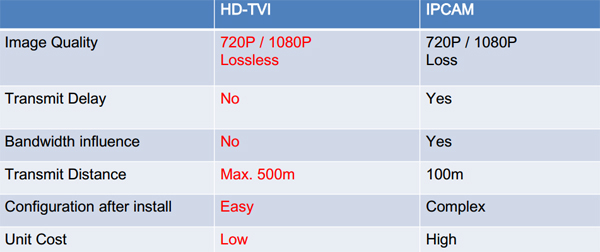
Hence, compared with IPC, the advantages of HD-TVI are
1.       No network bandwidth requirement/influence
2.       No network configuration, as easy as analog system
3.       No video quality loss and compression
4.       No video latency issue, real time live-view
5.       Long video transmission distance
6.       More affordable price for camera and video storage devices

AHD advantages

A new kind of camera: AHD Camera (Analog high definition)/HD-AHD is developing so soon in the market now.
The price is similar as Analog camera and the image effect is similar as digital camera!
The Advantages of AHD Camera:
1) AHD Camera can link with general DVR and the resolution is looks like 1000tvl analog cameras.
2) AHD Camera can link with AHD DVR, and the resolution is Megapixel High Definition ( Now have 1MP, 1.3MP already).
3) Transmit by Coaxial cable-500m!!
4) The price is similar as Analog system no matter considering DVR or camera.

HD-CVI cameras vs HD-AHD cameras

1.       1.0 megapixel AHD camera adopts OV9712 + NVP2431H solution (CMOS Chip: OV9712 & DSP Chips : Nextchip NVP2431H), while HD-CVI camera adopts the PO3100K + DH9801 solution. In addition to the difference of solution, the price vary greatly, OV9712 + NVP2431 of AHD camera module only costs US$7.5, and PO3100K + DH9801 camera module costs approximate US$11.
2.       AHD camera can connect to CRT display directly, the image can display properly. HD-CVI camera connects to traditional CRT, it doesn't show images. For video live view/recording/playback, HD-CVI cameras need to work with HD-CVI DVR. It seems, the HD-AHD cameras support 960H output mode, which is very convenient for test and installation. Since the AHD cameras can be backward compatible with all traditional analog equipment. Compared with HD-CVI, it has advantages of great compatibility.
3.       Competiable with normal D1 / 960H, and analog peripherals (including distributors, matrix, etc.). Switch AHD, IP and Anolog video signal from AHD DVR in no time.
4.       Strong anti-interference capability & solid interface protection that can avoid space high frequency electromagnetic radiation to ensure a constant signal transmission of high definition video display without problems as frame drop and lock loss occurred.
Back to Top